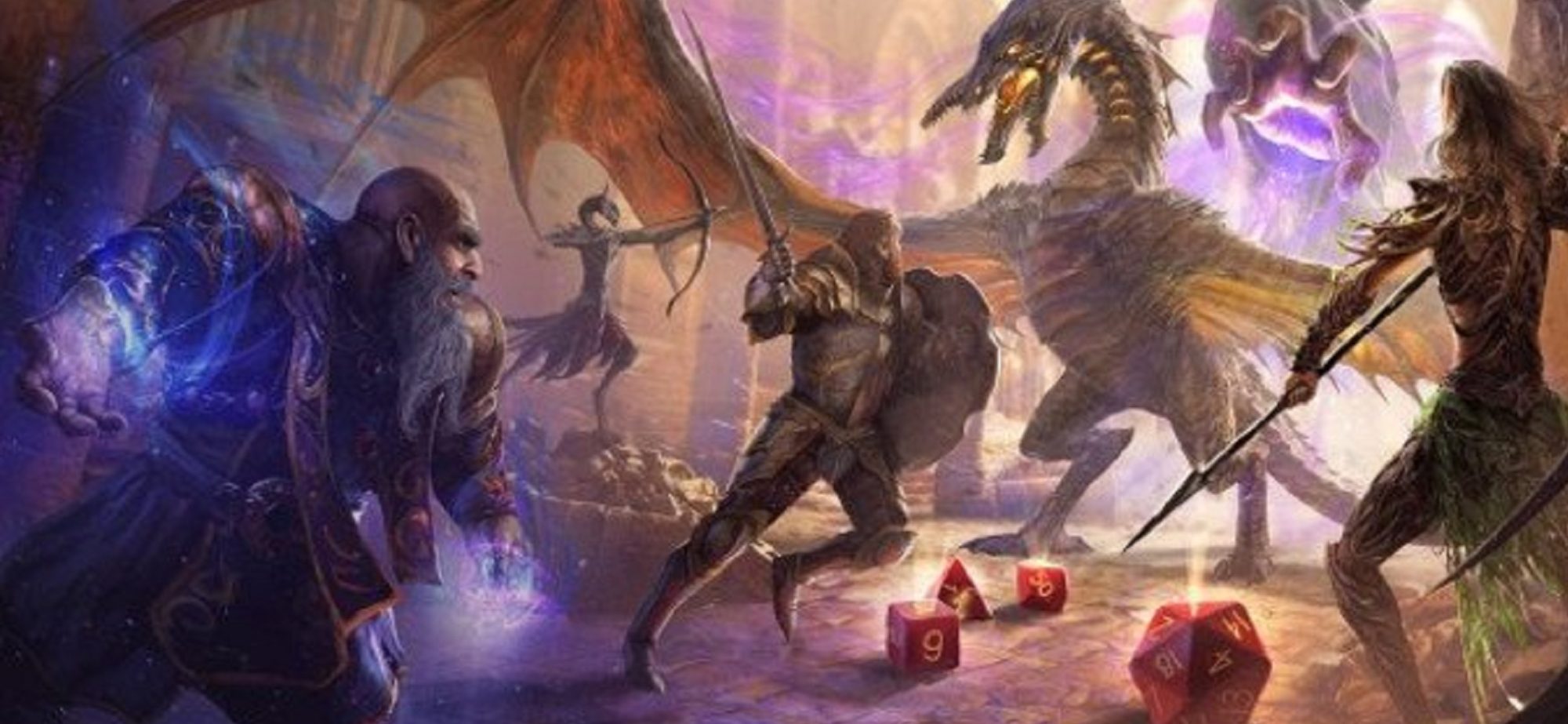
Stories do not tell us that monsters exist. We already know that. Stories tell us the monsters can be defeated.
Fantasy Role Playing Games (FRPGs) have been around since 1974, when the first edition of Dungeons and Dragons was published. Once considered a fringe hobby for the seriously nerdy, FRPGs are increasingly mainstream. In the media you’ll find everyone from Vin Diesel to Stephen Colbert to Ta-Nehisi Coates discussing their FRPG experiences. Academics are designing courses around role playing, teachers and therapists are using it to reach people in new ways, and companies are using it to teach teams to work together better.
In a FRPG, each player takes on the role, or “character”, of an adventurer, with a unique personality, traits, strengths and weaknesses. This is similar to an actor assuming a role, except that here there is no script. During the game you might play an elven wizard, a human warrior, or something even stranger. The rules will define some of your abilities, but giving your character life and personality is up to you.
Most of my games run using either Dungeons & Dragons 5th edition rules or a compatible variant thereof, such as Tales of the Valiant or Born From Ice. Other game systems such as Pathfinder, Heroes & Hardships, Talislanta, or newly published ones that catch my eye will occasionally be offered. You can find all my open games at StartPlaying.
The game flows as follows: The game master (GM, also called a Dungeon Master or DM) describes situations the characters run into. The players tell the GM what they intend to do in the situation. If it’s uncertain whether they can succeed at their intended actions, the GM may call for some dice to be rolled, with the results modified by the characters’ abilities. The GM then lets the players know the result of their actions, and they can then react to the changed situation. It’s shared storytelling. The players are in charge of their own destiny, while the GM runs the rest of the world around them.
The players are (normally) all on the same team. Either they all succeed or all fail together. They might have individual secondary goals that conflict, but if they lose sight of the main objective to pursue a rivalry, the whole party is endangered. It’s possible one or more characters may die during the story. If that happens, there will usually be some way for the player to rejoin the game, with a new character or a resurrection event of some sort.
The GM and the players are not adversaries, but the GM creates and plays all the obstacles that the players encounter. The GM’s task is to make the adventure challenging and engaging, with success and failure both possible based on the players’ decisions (and a bit of luck).
An adventure may be a single stand-alone session of 2 to 4 hours, or a long campaign in which each session’s events lead into the next. Characters created for one session can be played again (assuming they survived) in future sessions – with whatever magical loot or experience they’ve gained so far!
